Monday Style: A Handwritten Display Font That Feels Like Home
I was halfway through designing a set of soy candle labels—amber glass, linen tags, soft kraft paper sleeves—when I paused. The clean sans serif I’d been using felt crisp, yes, but not quite *warm*. Not quite *human*. That’s when I opened Monday Style, typed “Honey & Sage,” and watched the letters bloom across my screen like ink pressed gently into handmade paper. Its smooth, organic strokes didn’t shout—they breathed. And just like that, the whole label series clicked into place.
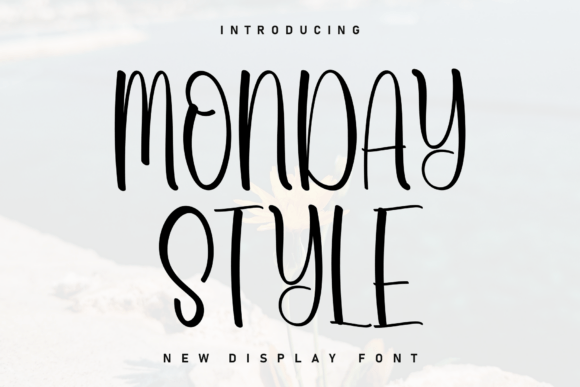
Monday Style is a handwritten display font with quiet confidence. It’s not fussy or overly ornate; instead, it carries a sense of heartfelt perfection—like a note written by someone who took their time, smiled while doing it, and meant every curve. The lowercase ‘a’ has a gentle loop, the ‘g’ curls with soft intention, and the capitals hold just enough presence to anchor a design without dominating it. It’s relaxed, but never careless. Friendly, but never generic. That balance is why it works so beautifully for makers who want their products to feel personal—not polished to sterility, but thoughtfully made.
I’ve used Monday Style across real projects: lavender-scented greeting cards where the font wraps around a pressed flower illustration; printable planner pages where “Weekly Intentions” sits at the top in soft, centered elegance; farmhouse-style wooden signs reading “Gather Here” with subtle shadowing to lift the letters off the grain; and even delicate wedding welcome boards where names flow like watercolor script beside hand-drawn vines.
For physical product labeling—candles, bath salts, herbal teas, small-batch jams—it shines at sizes 14–24 pt on matte sticker paper. The strokes remain legible when printed, and the natural variation in line weight adds tactile warmth you can’t fake with a rigid geometric font. On digital downloads—think printable wall art, seasonal SVG bundles for Cricut users, or editable Canva templates—the font reads cleanly on screens and holds up beautifully in PDF previews. Because it’s designed as a display font, it’s ideal for titles, names, short phrases, and decorative headings—not long paragraphs. That’s actually a strength: it invites focus, not fatigue.
When cutting with a Silhouette or Cricut, I always test a single word first at my intended size. With Monday Style, I’ve found it cuts cleanly down to 16 pt on vinyl (with no overlapping swashes enabled) and stays crisp even at 20 pt on thin kraft paper stickers. For smaller applications—like mini gift tags or tea bag labels—I avoid the most elaborate alternates and stick to the standard character set. The font includes thoughtful ligatures and stylistic alternates, but I only activate them when the context calls for extra charm—like a wedding invitation suite where “Mr. & Mrs.” flows seamlessly, or a boutique packaging tag where “Hand-poured • Small-batch” feels like a quiet promise.
Pairing Monday Style with other typefaces is intuitive. I often pair it with a warm, low-contrast sans serif—something like Montserrat Light or Poppins Regular—for body text on cards or product descriptions. The contrast lets Monday Style shine as the voice, while the sans serif plays the steady, supportive role. For more rustic or vintage-leaning projects, I’ll use it alongside a simple serif like Playfair Display (Regular weight) —the serif grounds the handwritten energy without competing. And yes, you *can* pair it with another script—but only if that second font is significantly more structured or formal, like a classic copperplate style used sparingly for monograms.
One thing I always check before finalizing any shop file is the included file formats and licensing. Monday Style comes in OTF and TTF, with full commercial use rights—meaning I can embed it in printable PDFs, use it on physical product labels, and even apply it to mugs, tote bags, or t-shirts sold in my shop. No hidden limits. I also glance at the character set: it supports basic Latin languages (English, Spanish, French, German), which covers most of my seasonal greeting card collections. If you’re designing for multilingual markets, double-check glyph coverage—but for everyday handmade goods, it’s thoughtfully complete.
What really surprised me was how Monday Style shaped customer perception—not through flashy marketing, but through consistency. When I used it across candle labels, Instagram story highlights, and digital download thumbnails, people began recognizing the rhythm of the letterforms. That subtle familiarity built quiet trust. A customer once wrote, “Your labels always feel like they belong together”—and that cohesion came from letting one expressive, well-designed handwritten font carry the voice across touchpoints.
It’s also become my go-to for seasonal shifts. In spring, I use Monday Style for “Fresh Cut Tulips” on market stall signage. In fall, it wraps around “Pumpkin Spice & Quiet Evenings” on printable mug wrap templates. At Christmas, it softens “Joyful Moments” on foil-stamped gift tags—never shouting, always inviting. Its versatility isn’t about being everything to everyone; it’s about being *just right* for moments that matter quietly.
If you work with physical materials—sticker sheets, kraft tags, fabric labels, ceramic decals—you’ll appreciate how Monday Style avoids thin hairlines or ultra-fine terminals that vanish when printed small or cut on textured surfaces. Its stroke contrast is gentle, its spacing open and generous. That translates directly to production value: cleaner cuts, fewer reprint requests, and packaging that looks intentional, not improvised.
At its heart, Monday Style is more than a font—it’s a tone-setter. It tells your customer, before they even read the words, that this was made with care. That the person behind the product paused, chose deliberately, and wanted the message to land softly but surely. Whether you're designing your first Etsy listing or refining a full brand identity, this display font doesn’t just sit on the page. It settles in—like a favorite pen, a trusted recipe, or the quiet certainty that what you make matters.